


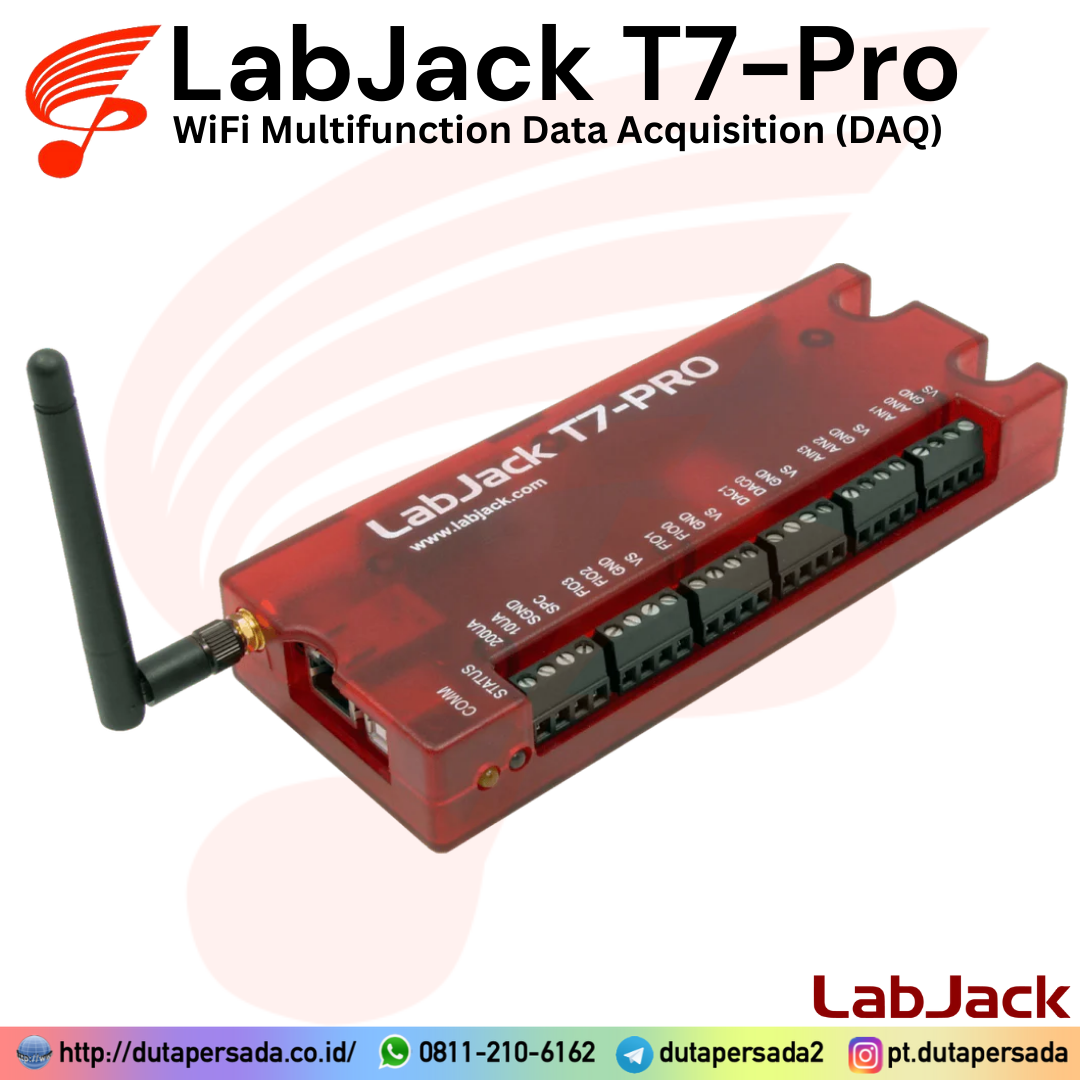


LabJack T7-Pro – Ethernet & USB Multifunction Data Acquisition with WiFi 24-bit (DAQ)
Stok 5
All the features of the normal T7 with the major addition of WiFi connectivity and an auxiliary low-speed high-resolution (24-bit) sigma-delta ADC. The T7-Pro also includes a real time clock (RTC) and 4GB MicroSD card for standalone datalogging.
With 14 instrumentation amplified analog inputs, software selectable gain settings, dozens of digital I/O features, and a Modbus TCP front-end, the T7 is our most versatile multifunction DAQ platform. Common applications include laboratory research, industrial control and monitoring, automated testing, and prototype development.
Status Barang: Ready
Kondisi: Baru
Minimal Order: 1 pcs
Labjack T7-Pro combines our highest performance 24-bit analog inputs with the convenient Ethernet or WiFi communication interface
What is the difference between the T7-Pro vs. T7?
The T7-Pro has the following additional features:
◆ 802.11b/g WiFi connectivity. (antenna included)
◆ Low-Speed and High-Resolution (24-bit) sigma-delta ADC.
◆ Battery Backed RTC for stand-alone data logging.
◆ Factory Installed 4Gb+ microSD card for stand-alone data logging.
OVERVIEW:
All the features of the normal T7 with the major addition of WiFi connectivity and an auxiliary low-speed high-resolution (24-bit) sigma-delta ADC. Choose the T7 series for ultimate flexibility. With 16-bit to 24-bit analog inputs, the option to use USB, Ethernet, and numerous built-in firmware features, the T7 Series can help you accomplish nearly any data acquisition need.
KEY FEATURES:
◆ 1μV noise-free analog input resolution
◆ Add optional expansion board for 84 analog inputs
◆ 24-bit low-speed and 16-bit high-speed ADC
◆ 23 Digital I/O
◆ 14 Analog Inputs
◆ Watchdog system
◆ Up to 10 counters
◆ Industrial range (-40° to +85°C)
◆ 2 Analog Outputs (12bit 0-5V)
◆ Serial protocols: SPI, I2C
◆ Up to 8 PWM, Quadrature, Pulse Width
◆ Instrumentation amplifier inputs: Single-Ended or Differential It’s great for acquiring signals from virtually any kind of sensor, and can serve that sensor data out through any of its 3 communication interfaces
EACH UNIT INCLUDES WITH:
◆ T7-Pro
◆ USB cable
◆ Ethernet Cable
◆ USB 5V power supply
◆ Screwdriver
◆ WiFi Antenna
| Berat | 1 kg |
|---|
Analog Input
- 14 Analog Inputs built in (16-24 Bits Depending on Speed & Device Type)
- Expand to 84 analog inputs with Mux80 add-on
- T7: 16-bit high-speed ADC (up to 100k samples/s)
- T7-Pro: 24-bit low-speed ADC (resolution as low as 1uV noise-free)
- Software Configurable Resolution Settings
- Single-Ended Inputs (14) or Differential Inputs (7)
- Analog input ranges: ±10V, ±1V, ±0.1V and ±0.01V
- All analog input features are software programmable by configuring the Analog Input Registers
- High speed sampling configurable by using Stream Mode. Speeds up to 100kS/s
- Low Latency Sampling and Control (less than 1ms) is made easy with Command-Response Modbus messages
- Easy integration with sensors like thermocouples, load cells, bridges, and more …
Analog Output
- 2 analog outputs (12-bit, 0-5V)
- Waveform generation via Stream Out
- Integrated LJTick-DAC support for multiple +/-10V outputs
Digital I/O
- 23 Digital I/O
- Supports SPI, I2C, and more… (Master Only)
- 5 PWM Outputs with individual phase control
- 5 Pulse Outputs with configurable number, frequency, and width
- 2 Frequency Inputs returning both frequency and period
- 2 Pulse Width Inputs measuring time spent high and low as well as duty cycle
- 2 Line-to-Line Inputs measuring the time between edges on 2 different lines
- 4 High-Speed Counters
- 6 Software Counters with debounce capabilities
- 3 Pairs of Quadrature Inputs
- Many of these DIO Extended Features share pins and cannot be used at the same time. See the DIO Extended Features section of the T7’s datasheet
Fixed Current Outputs
- 200 µA
- 10 µA
Communication Options
- USB
- Ethernet
- 802.11b/g WiFi (T7-Pro only)
Other Highlights
- Capable of stand-alone operation by running Lua Scripts
- Built-In CJC Temperature Sensor for easy thermocouple temperature readings
- Watchdog system
- Field Upgradable Firmware
- Programmable Startup Defaults
- Industrial temperature range (-40 to +85C)
- For more information please visit the hardware overview section of the T7’s datasheet
What is the difference between the T7-Pro vs. T7?
The T7-Pro has the following additional features:
- 802.11b/g WiFi connectivity. (antenna included)
- Low-Speed and High-Resolution (24-bit) sigma-delta ADC.
- Battery Backed RTC for stand-alone data logging.
- Factory Installed 4Gb+ microSD card for stand-alone data logging.
Based on 0 reviews
Be the first to review “LabJack T7-Pro – Ethernet & USB Multifunction Data Acquisition with WiFi 24-bit (DAQ)”
Produk Terkait
-
Ready StockData Acquisition (DAQ)
LabJack CB37 – Terminal Board for T7 U6 UE9 Series
Provides convenient screw terminals for the DB37 connector on the LabJack U6, UE9, and T7. Includes a screwdriver. Compatible with LJTick signal-conditioning modules.
The snaptrack shipped with this accessory is not compatible with DIN rail mounting systems. To mount this accessory to DIN rails, purchase our DIN Rail Mounting Clips, which come with 3D printed adapters that snap directly onto the accessory PCB.
SKU: LJ-CB37 -
Ready StockData Acquisition (DAQ)
LabJack T7 – Ethernet and USB Multifunction Data Acquisition DAQ 16-bit
Choose the LabJack T7 for ultimate power and data acquisition flexibility. With 16-bit analog inputs, the option to use USB or Ethernet, and numerous built-in firmware features, the T7 can help you accomplish nearly any DAQ need. The LabJack T7 also has 2 analog outputs (12-bit), 23 digital I/O, and up to 10 digital counters/timers.
With 14 instrumentation amplified analog inputs, software selectable gain settings, dozens of digital I/O features, and a Modbus TCP front-end, the T7 is a versatile multifunction DAQ platform. Common applications include laboratory research, industrial control and monitoring, automated testing, and prototype development. Additionally, T7 devices are capable of stand-alone operation by running Lua scripts.
SKU: LJ-T7 -
Ready StockData Acquisition (DAQ)
LabJack T4 – Multifunction Data Acquisition with Ethernet & USB
Choose the T4 for low cost Ethernet connectivity and the same software API as our flagship T7 device. The T4 has 4 dedicated high voltage (±10V, 12-bit resolution) as well as up to 8 configurable low voltage analog inputs (0-2.5V, 12-bit resolution). The T4 also has numerous built-in firmware features to help users accomplish most data acquisition needs.
SKU: LJ-T4 -
Ready StockData Acquisition (DAQ)
LabJack LJTick-CurrentShunt – (LJTCS) for U3, U6, UE9, T7, or T4 Series
The LJTick-CurrentShunt (LJTCS) is a signal-conditioning module designed to convert a 4-20 mA current loop input signal into a 0.47-2.36 volt signal compatible with the LabJack U3, U6, UE9, T7, or T4. The 4-pin design plugs into the standard AIN/AIN/GND/VS screw terminal block found on LabJacks such as the U3, U6, UE9, T7, and T4.
SKU: LJ-TickCurrentShunt



There are no reviews yet.